

Gratuitous Precision
Precision isn’t always necessary. But practicing it changes what the eye becomes capable of seeing.

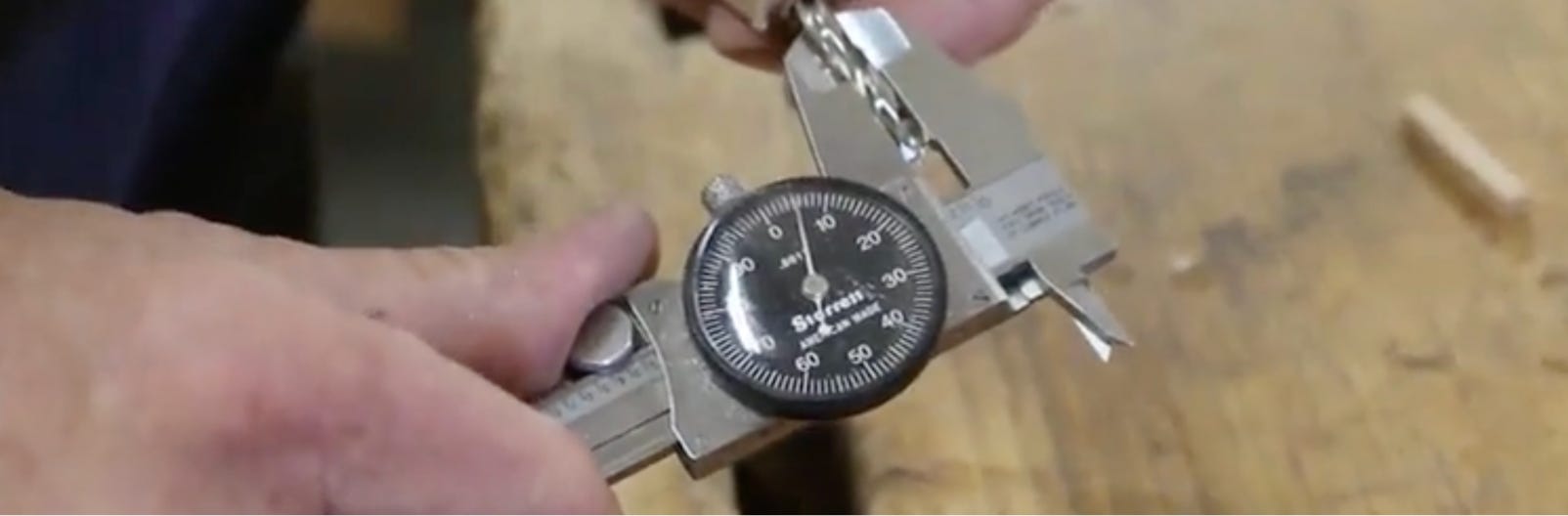
We first shared this essay several weeks ago without sending it to our full list. The response convinced us it deserved a proper introduction. So today we’re officially sharing it here.
Most woodworking projects don’t require extreme precision. But practicing precision, even when it isn’t necessary, can fundamentally change how well your eye understands the work.
About forty years ago a student of mine, Tony Hull, gave me a pair of calipers. After that I began measuring almost everything I made to within a thousandth or two, or at least within whatever tolerance I thought I could hit.
At first that may sound like a path toward dependence on measuring devices, but what it really did was give me a new way to train my eye.
As I’ve gotten older, my eyesight has diminished, but my eye has improved.
By “eye,” I’m referring to what the brain does with incoming visual information. The precision of the measuring system we use becomes the precision our brain learns to recognize. If the finest measurement on your ruler is a sixteenth of an inch, then that’s the finest level of distinction you’re training your brain to see.
Even when working with fractions, a sixty-fourth of an inch is usually the smallest number we deal with. That means the numerical measuring system most woodworkers use effectively stops at about fifteen thousandths of an inch.
Calipers don’t.
They give the brain a much finer vocabulary, a smaller set of numbers through which it can understand how big something actually is.
There are many processes I teach that produce far more precision than the task strictly requires. They’re often my go-to methods because they work reliably and allow me to reach levels of accuracy beyond what the moment demands.
Over time I realized something: practicing gratuitous precision improves my fluency in the language of measurement.
It’s like learning a foreign language. For many woodworkers, this level of precision is exactly that, a foreign language. If you only speak it occasionally, it will always feel awkward when you need it. But if you practice it constantly, the language becomes natural.
Then when a truly precise operation is required, you can move through it easily, hit your dimensions, and enjoy the process a lot more.
From the Bench,
Brian Boggs
Thank you Brian. Always sage and useful advice from you. I like your idea about being over precise in measuring and the why behind it.
Cheers,
Michael