

Why I Left the Round Leg
What happened when I stopped letting tradition answer the structural questions for me

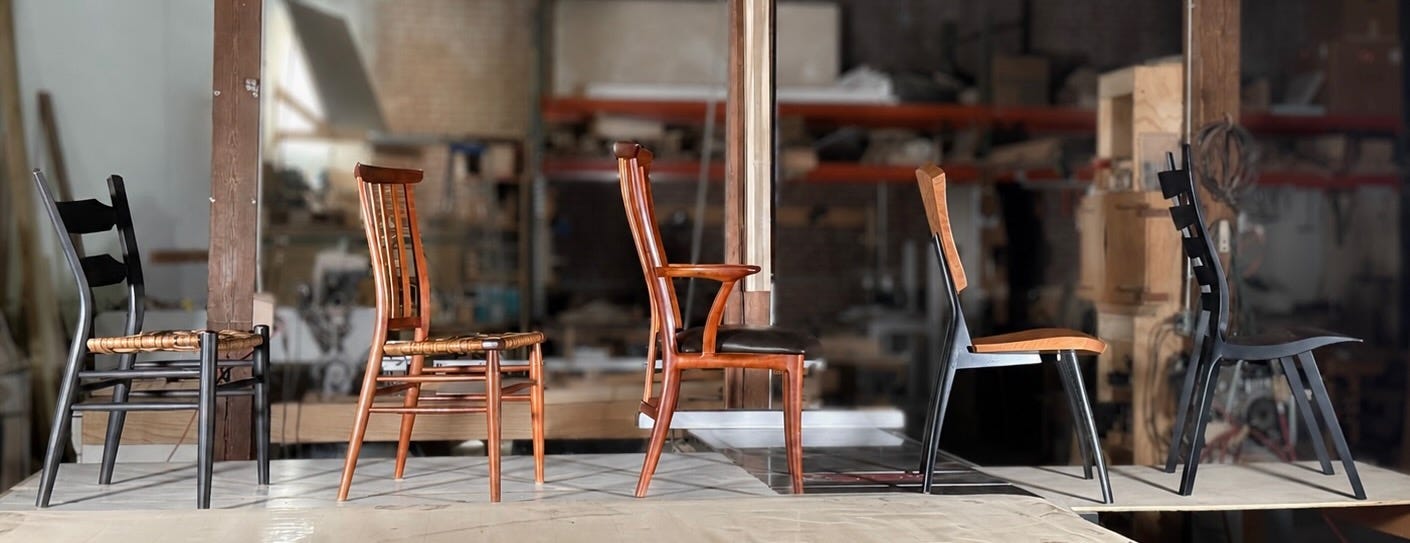
Brian walks through this evolution in a video below.
I’ve always asked myself why things are made the way they are. Chairs in particular.That seems to be where my making brain tends to roam the most.
When I started making post and rung chairs, I didn’t have much equipment. That was part of the attraction. A post and rung chair can be made in an extraordinarily simple shop. You don’t need a lot of machinery or elaborate fixtures. With a few tools and the right wood, you can make a very good chair.
So in the beginning, the decision was obvious. It was the kind of furniture I could make with the equipment I could afford.
But after hundreds of chairs, I started asking a different question.
Why are the legs round?
Why are the rungs round?
Why are the joints round?
There are good historical answers to all of those questions. Round parts are efficient to make with simple technology. A round tenon fits naturally into a bored hole. The whole system works beautifully with the tools, materials, and methods from which the tradition evolved.
But at some point, a historical explanation stopped being enough for me.
I wanted to know whether the round leg was still serving the chair, or whether I was simply continuing to make it round because that was how chairs like this had always been made.
To make a round leg, you generally begin with something closer to a square. Even if the piece has been riven from a log and shaped by hand, when you start the work you have a lot more material than you will have when the leg is finished.
What do you take away, and exactly why do you take it away?
I held those questions while shaping lots and lots of legs.
And they started bothering me.
There is a lot of useful real estate in those corners.
If you leave the leg square, or at least allow yourself to work with something other than a round section, you suddenly have more options for joinery. More importantly, you have more opportunities to take advantage of how stress actually moves through a chair.
That became the more interesting challenge for me.
If you sit in a chair and push back against the back leg, the stress is concentrated on the outside surface of that leg where it meets the seat structure. If you twist in the chair, which I do constantly, you are loading the leg from the sides as well.
But in a conventional post and rung chair, the rung typically enters the leg near the center. Structurally, that always struck me as an opportunity being missed.
I was also aware from various tests that round legs offer a resistance to twist—or rather, they allow the frame to twist without damage. This allows them to rest flat on a floor that isn’t, or give under stress like a sapling in the wind.
The twisting force is being applied out toward the surface, while the joint resisting it is concentrated farther toward the center. The collective efforts of ten stretchers generally keep things together.
Once the leg no longer has to be round, the joint no longer has to be round either. The options for making much stronger joints increase dramatically. A larger joint with more massive parts won’t twist like a post and rung chair, but does it need to?
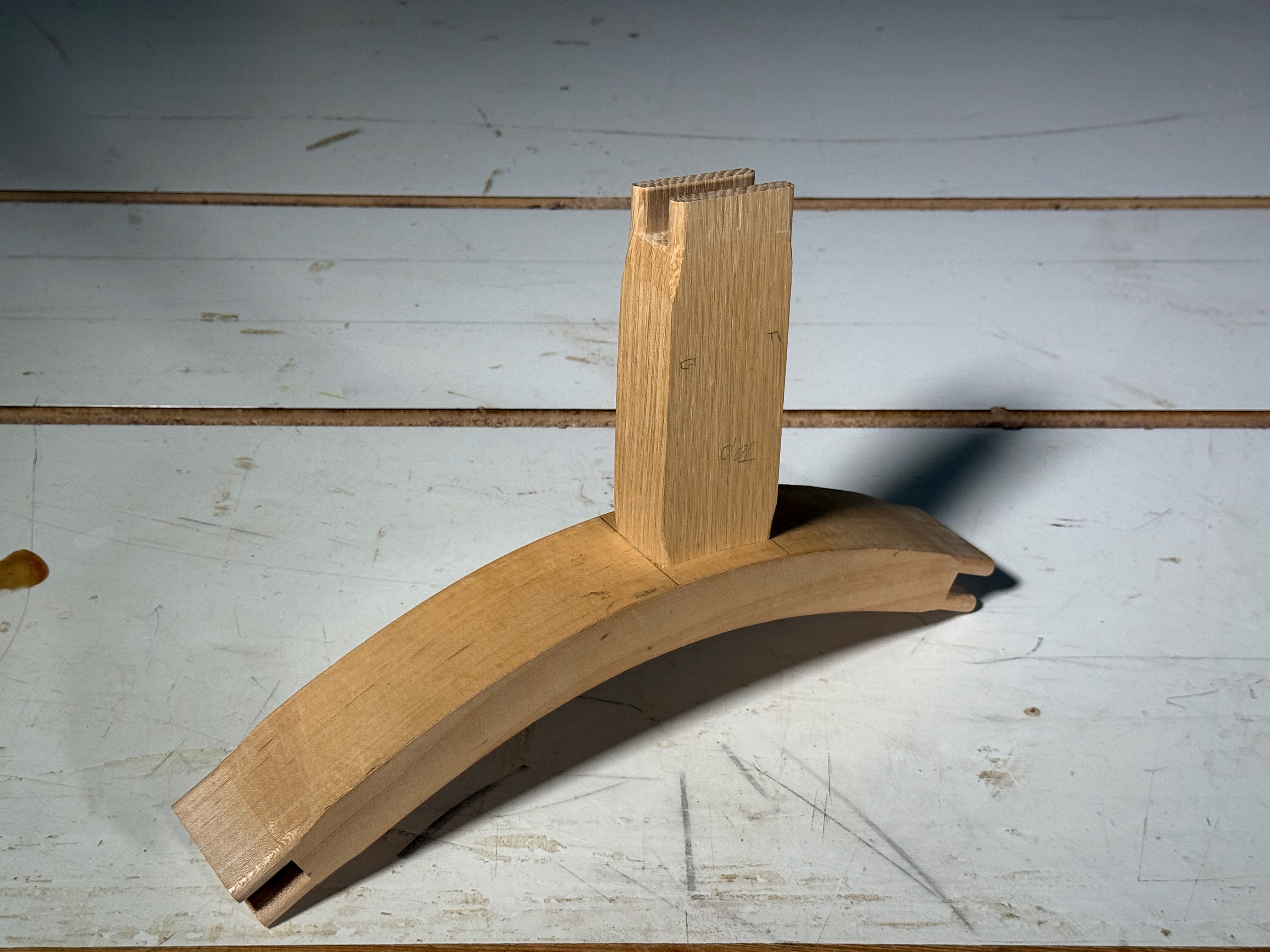
Brian’s Universal Joint
Before making the wholesale shift to square legs, I began using double tenons on what I called the Universal Joint. That allowed me to spread the connection farther apart and move the joinery closer to the outside surfaces of the leg. Instead of asking the leg to carry the stress inward before the joint could resist it, I could put the structural strength closer to where the stress begins.
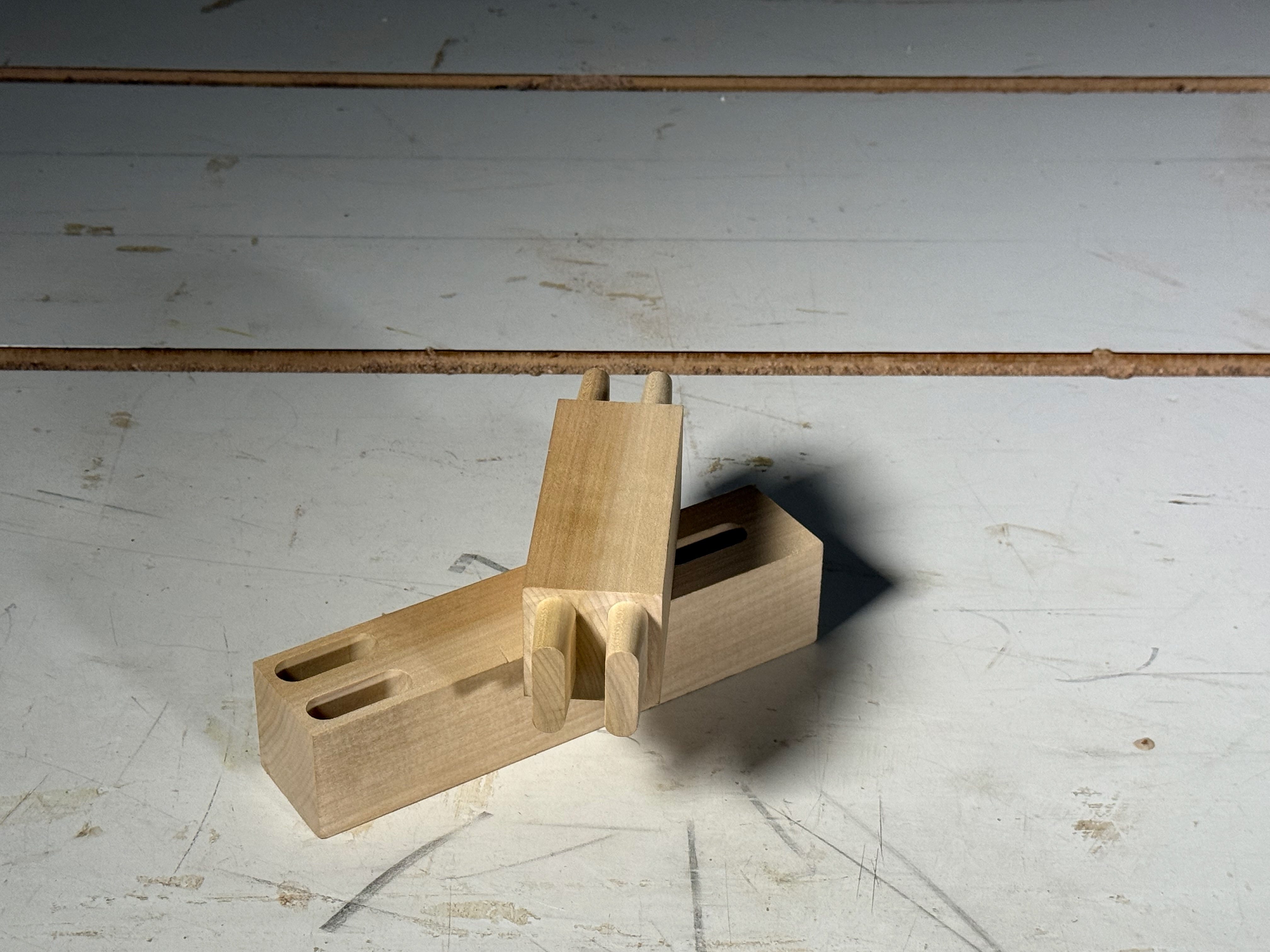
Brian’s double tapered mortise and tenon
It also gave me nearly seven square inches of bonding surface instead of about three in a round rung. The joint was an inch and a half high, with four planes of glue surface. That gave it a lot more strength to resist stress.
That made more sense to me.
It also helped me change the way I thought about where the mass of a chair belongs.
If the important structural problem is the connection between the leg and whatever carries the seat, then that is where I want the wood. I don’t necessarily want to start with that useful mass and peel it away just to arrive at a round leg.
Leave the material where it can do some work.
Now, there is an obvious argument against all of this.
Why question a form that has worked for centuries?
It is a good argument.
We have surviving post and rung chairs and Windsors that are hundreds of years old. I have made a lot of chairs using those traditions, and I’m proud of them. I have a greenwood chair here that I made about fifteen years ago with no glue in the rung joints. It is as tight today as it was when I made it.
There is nothing inherently wrong with the system.
But those chairs also grew out of a relationship between structure, process, and very particular materials.
The woods traditionally used for post and rung chairs weren’t incidental choices. The properties of those species were part of the technology.
Once you move into a different kind of furniture market, the wood preferences change. A client buying a more highly designed chair may want walnut or cherry. Those woods don’t necessarily behave the way the traditional woods of a ladderback or Windsor do, and they don’t always lend themselves to the same processes.
There are several reasons why you don’t see many antique walnut post and rung chairs.
1 Walnut isn’t strong enough for this design as traditionally wrought.
2. This was the peasant’s chair. Walnut is expensive.
3. Walnut does not bend as easily as less expensive woods like oak, ash, hickory or soft maple.
If I want to build a chair in walnut or cherry, it makes sense to me to reconsider the structure rather than force those materials into a system developed around a different set of properties.
That doesn’t condemn the historic chair.
It just means I can disobey the rules at great risk, or take a different path altogether.
And that, eventually, became the real reason I walked away from the round leg.
It wasn’t because the round leg had failed.
It was because solving the structural problem differently gave me much more freedom of design and material choice.
Once I could transfer enough strength through the seat structure effectively into the legs, the need for a lower carriage could begin to disappear. That wasn’t only a structural gain. It changed the visual character of the chair.
That was a huge change.
A post and rung chair carries a lot of its structure where you can see it. Rungs cross at different heights on all four sides, front to back, side to side, doing the only job they can do, which is keep the legs from spreading. It works. It has worked for centuries. But it is also visually busy—a kind of structural noise under the seat that has nothing to do with beauty, only with keeping the chair standing.
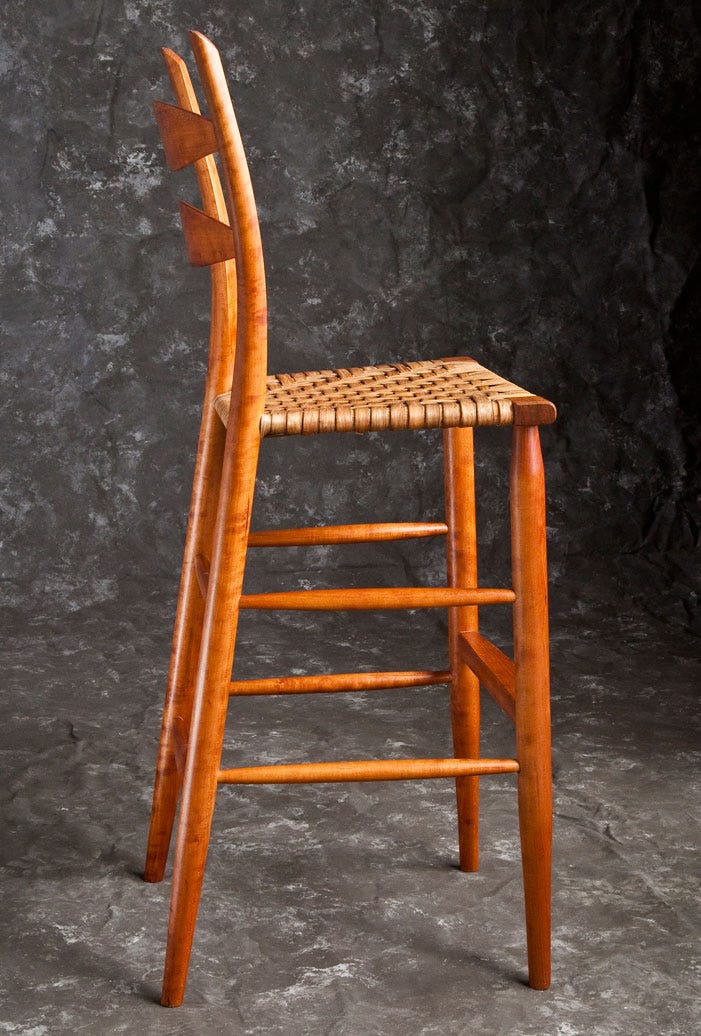
Boggs Berea Ladderback bar stool
If I no longer needed stretchers and joints below the seat to stabilize the chair, that noise left with them. Four legs, nothing between them, nothing left to resolve. The eye doesn’t have to sort through a lattice of rungs to find the chair. It just sees it.
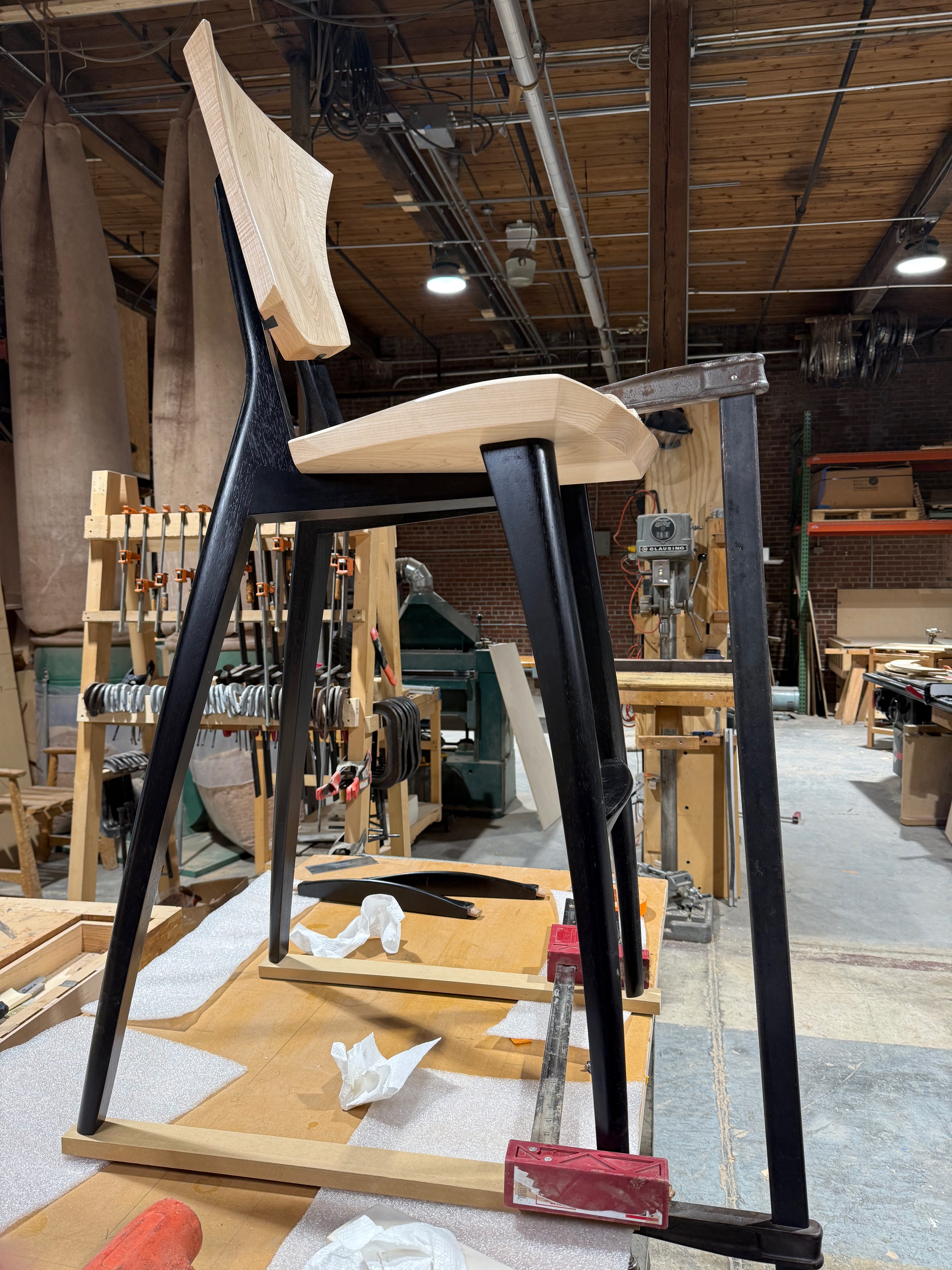
Boggs Lily bar stool
The leg could take a route, too. It could change shape. It could change direction. The relationship between the seat and the floor could change completely.
Then the seat options change.
Then the back options change.
One structural decision opened nearly everything else.
That is what interested me.
I wasn’t trying to make a post and rung chair better than the post and rung chair. I was trying to stop allowing the conventions of that structure to answer questions I hadn’t asked yet.
Once the primary structural problem was addressed differently, I could move on to other questions.
How should the chair support the thoracic and lumbar curves?
How do I stabilize the frame?
How do I create seat comfort without relying on a cushion?
How much material do I actually need, and where does it need to be?
Those questions became much more open once I stopped requiring the answers to end in round legs, round rungs, and round tenons.
And I still don’t think I’ve found the limits of that freedom.
For me, that has become one of the most useful ways to think about chair design. Start with the forces. Figure out where the stress begins and how you can move it through the structure most effectively.
Then see what becomes possible.
Sometimes a form survives for centuries because it is extraordinarily good at what it was designed to do. And if it ain’t broke, why fix it?
But I was hearing new voices that wanted to join the chairmaker’s choir. They needed new processes and new forms in order to become.
Sometimes the tradition gives you the answer.
And sometimes it gives you the question.
I’ll hang on to the questions while I play with the ideas they beckon me toward.
From the Bench - Brian Boggs
If something I have shared here has taught you something, changed the way you think about your work, or simply made you curious to try something new, an $8 paid subscription is one way you can help me keep sharing lessons from the bench.
We’re not putting up a paywall. We’re asking for your support. There won’t be a separate stream of writing reserved for paid subscribers. We’d rather everyone get to read it.